How do we create authentic sustainability in business? The short answer is – by balancing your triple bottom line of Planet, People, and Profit. However, that answer is general at best, and far from operational. To make this more usable, one has to create a richer definition.
Profit is fairly easily understood; the definition wikipedia uses for “normal profit” is
The return the entrepreneur can expect to earn or the profit that a business owner considers necessary to make running the business worth his/her while.
Questions about what the owner considers “necessary” arise, but we will leave those questions to other posts.
“Planet,” perhaps a little more challenging, is still graspable – if we imagine our natural resources as bank account, from which we draw the interest, we can understand that our actions could (are) diving into the “reserves” of the planet; thus, we need to change our actions to minimize our planetary expenditures and perhaps to restore and build our planetary reserves again – building our planetary bottomline, and balancing that bottomline against our eonomic bottomline.
However, how do you build the reserves of the bottom line of “people”? It is a nebulous question in many ways – what “people” are we referring to, first, and then, how do we “build” it, “balance” it, or do whatever else is needed in order to achieve sustainability in a company? Finally, how does this relate to social responsibility, living wage, social equity, and all of the other ideas that get lumped together in this general category?
Defining People
The first step is to define what we mean by “people.” One model that has been helpful to me: a matrix defining the organizational territory as being composed of Individuals and Collectives, who likewise each have Internal and External Landscapes. First discussed by Ken Wilbur (who doubtless based his thinking on many others) and then connected to the “Enterprise” by Christopher Peck and John Stayton in a class about Sustainable Local Enterprise they used to teach for the Green MBA, the following matrix has helped me articulate well the organizational terrain.
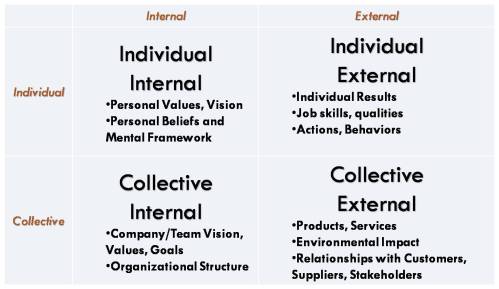
developed by John Stayton, Christopher Peck based on Ken Wilbur's Work
As the model illustrates, there are four “Realms” in an organization: the Individual Internal, the Individual External, the Collective Internal, and the Collective External. By defining “people” we have actually created a doorway into what I would call “Authentic Sustainability.”
I would posit that for a company to be authentically sustainable – it needs to have sustainability infused into each of these Realms. And here is where the definition for the Triple Bottom Line doesn’t yield enough – we are left with the question unanswered of how can we infuse planet, profit, and people into each of these four areas?
To answer this question, I go back to Bill McDonough, author of Cradle to Cradle and Green Designer. When defining sustainability, he takes as his operational quest the following:
How do we love all the children, of all species, for all time?
With this quote, McDonaugh points to the quest that is at the center of all authentic sustainability efforts: the quest for life. To me, the nature of sustainability in business is a three-fold quest:
- a quest for to sustain and improve the well-being of the life of the organization
- a quest to sustain the lives and well-being of the people and species (natural resources) internal to its organization – its employees, the natural resources needed for its products and services
- a quest to sustain the lives and well-being of the people and species (natural resources) external to its organization – its customers, its suppliers and stakeholders, the environment its products, processes and services effect.
Ultimately, the path of the sustainable organization is one that is life–affirming. This means both good news and bad news for the sustainability champion.
The good news? There is a lot that we are already doing in our organizations that is inherently life-affirming. Think in your own organization; when we see our employees as people, with aspirations and needs of their own (an effort that would rest in the internal individual quadrant), we are affirming life. When we pay our employees what they deserve (external individual), and have honest conversations with them when we can’t, yet again we are affirming life. The teambuilding efforts, the collaborative engagement dollars spent on developing an organizational vision, establishing teamwork between departments are also all life-affirming and key components to affirming the life of the organization and the people who work inside of it. Practices for authentic sustainability are, in reality, good business practices that sustain the organization, the people it serves, and the environment it is a part of.
The bad news? Being a sustainable company isn’t cut and dry. In fact, once you start this journey, it can impose standards that are challenging to meet – one reaction could be, Gee, you mean I have to be all that, too? Yes, in reality, you have to be that too. Why? Being accused of greenwashing could be damaging – most likely undoing your efforts.
Next post? How striving for “authentic” sustainability will help you avoid greenwashing, AND create a business, a planet, and a staff that will be around for the long haul.
 Genevieve Taylor's Blog
Recent Comments