In the last post, we talked about managing the psychological impacts of change. We talked about how change is inevitable, as are the emotional consequence of change. Lets dive a little deeper in how you negotiate the waves of change for your own, and others’, benefit.
The Leader of Influence
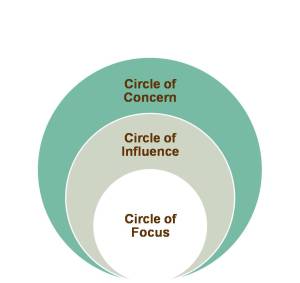
Covey's Circle of Focus
In the post, Tactics for Leading Change, I made the argument that a Leader’s most effective long-term tool is that of influence. Influence, while being a less direct route to making change, has a much larger impact.
The tool shown here is modified from Stephen Covey’s “Circle of Focus” first described in The Seven Habits of Highly Effective People. The Circle of Focus contains anything whose behavior you can directly control. This includes you, your dog (possibly), your small child (before they begin walking, maybe), and, for a very short time, anyone who you are able to exercise direct power and authority over. I say a short time, because if you have to exercise direct power and authority for long periods of time, you are likely engaged in a power struggle which can tend towards dysfunctional, passive-aggressive behaviors.
So, lets say that the Circle of Focus contains, essentially and most functionally, you. The Circle of Influence contains anything that you have some degree of, well, influence, that directly affects you and thus warrants you exercising your influence. Typically, you must work with others in this circle – you can’t effectively get the outcome most beneficial to you without the help of others. Thus, we spend much of our time in the Circle of Influence. Read More…
 Genevieve Taylor's Blog
Recent Comments